This is a short tutorial on the Fréchet derivative and some key properties. The Fréchet derivative is a notion of directional derivative in Banach spaces and is used a lot in optimal control (e.g., in Pontryagin’s maximum principle).
Definition
Let $V$ and $W$ be normed vector spaces, and $U\subseteq V$ be an open subset of $V$. A function $f : U \to W$ is called Fréchet differentiable at $x \in U$ if there exists a bounded linear operator $A:V\to W$ such that
$$\lim_{\Vert h\Vert \to 0} \frac{\Vert f(x + h) - f(x) - Ah\Vert_W}{\Vert h\Vert_V} = 0.$$
Equivalently, we can say that as $\Vert h\Vert \to 0$ we have1
$$f(x + h) = f(x) + Ah + o(h).$$
If such an operator exists we write $\mathrm{D}f(x) = A$; this is a function $\mathrm{D}f: U \to B(V, W)$, where $B(V, W)$ is the set of bounded linear operators from $V$ to $W$. We can think of $\mathrm{D}f(x)[h]$ as the derivative of $f$ at $x$ along the direction $h$; this is linear in $h$.Spivak2 proves that for functions $F:\R^n\to\R^m$, if such a linear map exists, it is unique.
We also have the following formula that $\mathrm{D}f(x)$ satisfies
Calculation from Gâteaux derivative. The Fréchet derivative satisfies
$$\mathrm{D}f(x)[h] = \lim_{t\to 0}\frac{f(x+th) - f(x)}{t} = \frac{\mathrm{d}}{\mathrm{d} t}f(x+th)\bigg|_{t=0},$$
that is, if it exists, it equals the Gâteaux derivative of $f$.
In other words, If a function is Fréchet-differentiable, then it is also Gâteaux-differentiable, and the two derivatives coincide.
The Fréchet derivative is a generalisation of the total derivative. The total derivative is precisely the Fréchet derivative when $V$ and $W$ are Euclidean spaces ($\R^n$ and $\R^m$).
Linearity
Firstly, the Fréchet derivative is linear in the following sense
- $\mathrm{D}(cf)(x) = c\mathrm{D}f(x)$
- $\mathrm{D}(f+g)(x) = \mathrm{D}f(x) + \mathrm{D}g(x)$
A simple observation is that if $A: V \to W$ is a bounded linear operator, then $\mathrm{D}A(x)[h] = Ah$. Now consider the space $V = H^1([0, 1], {\rm I\!R})$ (a Sobolev space) and $W = L^2([0, 1], {\rm I\!R})$ and let $A: x \mapsto \dot{x}$, which is a bounded linear operator. Then,
$$\mathrm{D} \dot{x}[h] = \dot{h}.$$
Several variables
Let $U, V, W$ be vector spaces and we have a Fréchet-differentiable function $F:U\times V \to W$. In that case, the Gâteaux derivative, $\mathrm{d}F(x, y)[\dot{x}, \dot{y}]$, is linear in $\dot{x}, \dot{y}$, that is $$\mathrm{d}F(x, y)[\dot{x}, \dot{y}] = A(x, y)\dot{x} + B(x, y)\dot{y}.$$ For $\dot{y}=0$, $$\mathrm{d}F(x, y)[\dot{x}, 0] = A(x, y)\dot{x}.$$ Using the definition of the Gâteaux derivative, we see that $A$ is the Gâteaux derivative of the mapping $x\mapsto F(x, y)$. We conclude that
Gâteaux derivative in several variables. Let $F:U\times V\to W$ be Fréchet differentiable. Then
$$\mathrm{d}F(x, y)[\dot{x}, \dot{y}] = \mathrm{d}_x F(x, y)[\dot{x}] + \mathrm{d}_y F(x, y)[\dot{y}].$$
Relation to Gateaux derivative
If $f$ is Fréchet differentiable at $x$ it is also Gâteaux differentiable at $x$. Note, however, that although the Fréchet derivative is linear, the Gâteaux derivative may not be.
If $f$ is Fréchet differentiable, then its Fréchet derivative is a linear map $$\mathrm{D}f(x): v\mapsto \mathrm{d}f(x)[v],$$ that is, the Fréchet derivative can be used to determine the Gâteaux derivative of $f$.
A function can be Gâteaux differentiable, but not Fréchet differentiable. In particular, $\mathrm{d}f(x)[v]$ may not be linear in $v$.
Relation to $C^1$
If all partial derivatives of $f$ exist and are continuous, then $f$ is Fréchet differentiable. However, a function can be Fréchet differentiable without being $C^1$. Here is a counterexample3 $$ f(x, y) {}={} \begin{cases} (x^2 + y^2)\sin\frac{1}{\sqrt{x^2 + y^2}}, & \text{ if } (x,y)\neq (0, 0) \\ 0, & \text{ otherwise} \end{cases} $$ This function has a Fréchet derivative, but does not have continuous derivatives at the origin. The function looks like this.
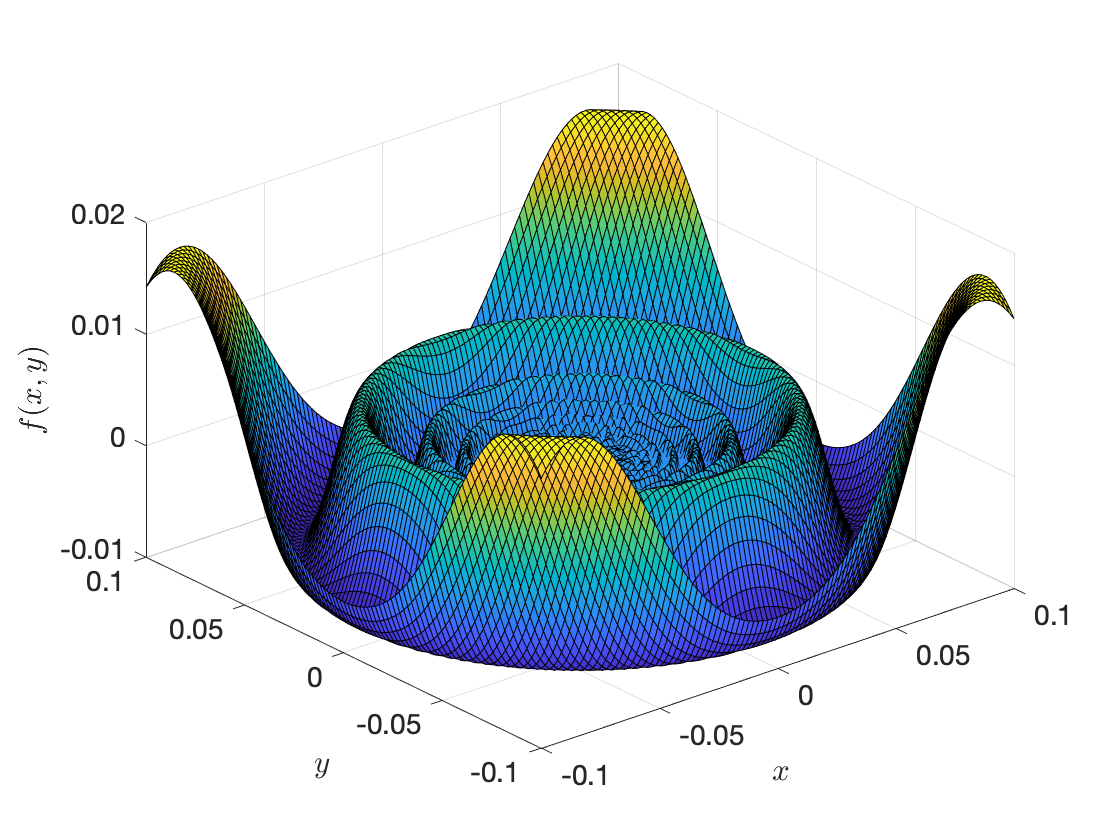
Figure 1. Plot of function $f(x, y)$.
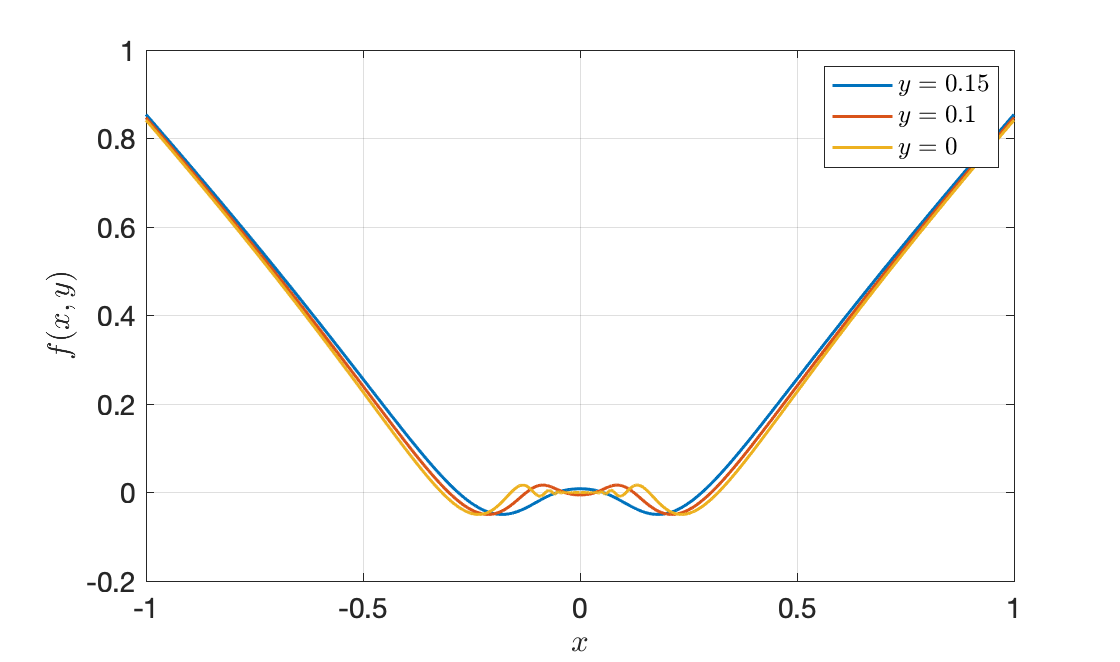
Figure 2. Slices of $f$ for constant $y$.
and the partial derivative wrt $x$ is $$ \frac{\partial f(x, y)}{\partial x} {}={} 2,x,\sin\left(\frac{1}{\sqrt{x^2+y^2}}\right)-\frac{x,\cos\left(\frac{1}{\sqrt{x^2+y^2}}\right)}{\sqrt{x^2+y^2}},$$ for $(x, y)\leq 0$. We can see that the partial derivative at zero does not exist and the limit of this partial derivative at zero does not exist.
Chain rule
The chain rule for the Fréchet derivative is as follows
This means that $$\mathrm{d}(G\circ F)(x)[v] = \mathrm{d}G(F(x))[\mathrm{D}F(x)[v]],$$ for all $v$.
Proof4. By definition, $F(x+v) = F(x) + \mathrm{D}F(x)[v] + o(|v|)$. We apply this to $G\circ F$
$$\begin{aligned}(G\circ F)(x+v) {}={}& G(F(x+v)) \\ {}={}& G(F(x) + \underbrace{\mathrm{D}F(x)[v] + o(\|v\|)}_{\text{direction}}) \\ {}={}& G(F(x)) + DG(F(x))[\mathrm{D}F(x)[v] + o(\|v\|)] \\&\quad+ \underbrace{o(\|\mathrm{D}F(x)[v] + o(\|v\|)\|)}_{o(\|v\|)} \\ {}={}& G(F(x)) + DG(F(x))[\mathrm{D}F(x)[v]] + o(\|v\|),\end{aligned}$$
so, to summarise $$ (G\circ F)(x+v) {}={} G(F(x)) + DG(F(x))[DF(x)[v]] + o(|v|). $$ This completes the proof. $\Box$
Higher order Fréchet derivative
The Fréchet derivative is very general. We defined the Fréchet derivative of a mapping $f:V\to W$, where $V$ and $W$ are just vector spaces. We saw that the Fréchet derivative is a map $\mathrm{D}f: V \to {\rm Hom}(V, W)$. The Fréchet derivative of the Fréchet derivative is the second Fréchet derivative, which is a map
$$\mathrm{D}^2f : V \to {\rm Hom}(V, {\rm Hom}(V, W)) \cong {\rm Hom}(V\otimes V, W),$$
where the last isomorphism with the tensor product holds provided $V$ is finite dimensional. We can likewise define Fréchet derivatives of order $k$; these are mappings $$\mathrm{D}^k f:V \to {\rm Hom}(V^{\otimes k} , W),$$ with $V$ finite dimensional.Note. It makes sense: $\mathrm{D}f(x)$ is a linear operator. Naturally, $\mathrm{D}^2f(x)$ is a bilinear operator, and $\mathrm{D}^kf(x)$ is $k$-linear. Hence the tensors.
From the above, we also see that $\mathrm{D}f(x):V \to W$ is linear, $\mathrm{D}^2f(x): V\times V \to W$ is bilinear, $\mathrm{D}^3 f(x): X\times X \times X \to W$, etc. We can also say that $$\mathrm{D}^kf(x): \underbrace{V\otimes \cdots \otimes V}_{k \text{ times}} \to W,$$ is linear, i.e., we have a $\mathrm{D}^kf(x)[\mathrm{d} x_1 \otimes \ldots \otimes \mathrm{d} x_k]$.
Fréchet derivative of bilinear operators
This is from5 (Example 5, p. 231).
Bilinear operators. Let $b:X\times X\to Y$ be a bilinear bounded operator, where $X_1$, $X_2$, and $Y$ are Banach spaces. Let $X \coloneqq X_1 \times X_2$. Then, $b$ is Fréchet differentiable infinitely many times and for $x, h\in X$,
$$\mathrm{D}b(x)(h) = b(h_1, x_2) + b(x_1, h_2).$$
Proof. For the proof we’ll first determine the Gâteaux derivative of $b$. We have
$$\begin{aligned}b(x+th)={}&b(x_1+th_1, x_2 + th_2) \\ {}={}& b(x_1, x_2) + t(b(h_1, x_2)+b(x_1, h_2))+t^2b(h_1, h_2).\end{aligned}$$
Therefore, the Gâteaux derivative of $b$ at $u$ along $h$ is
$$\begin{aligned} \mathrm{d}f(x)(h) {}={}& \lim_{t\to 0}\frac{b(x+th) - b(x)}{t} \\{}={}& \lim_{t\to 0}\frac{t(b(h_1, x_2)+b(x_1, h_2))+t^2b(h_1, h_2)}{t} \\{}={}&b(h_1, x_2)+b(x_1, h_2). \end{aligned}$$
This proves that $\mathrm{d} b(x)(h) = b(h_1, x_2)+b(x_1, h_2)$.Actually, from the first equation we see that
$$\begin{aligned} b(x+h){}={}& b(x) + \underbrace{b(h_1, x_2)+b(x_1, h_2)}_{Ah}+B(h). \end{aligned}$$
To show that $\mathrm{D}b(x) = A$ it suffices to show that $b(h) = o(h)$. It is5. The Fréchet derivative of $b$ is $\Box$
Some other examples are given in6.
Taylor’s formula in Banach spaces
Let $U$ be an open subset of a real Banach space $X$. If $f: U \to \R$ is differentiable $n+1$ times on $U$, it may be expanded by Taylor’s formula7:
$$\begin{aligned}f(x+h) ={}& f(x) + \mathrm{D} f(x) (h) + \frac{1}{2!} \mathrm{D}^2 f(x)(h, h) + \ldots \\ &+ \frac{1}{n!} \mathrm{D}^n f(x) (h, h, \ldots, h) + R_n(h),\end{aligned}$$
where $R_n$ is the remainder.
In7 they use the notation
$$\begin{aligned}f(x+h) ={}& f(x) + \mathrm{D} f(x) \cdot h + \frac{1}{2!} \mathrm{D}^2 f(x) \cdot h^2 + \ldots \\ &+ \frac{1}{n!} \mathrm{D}^n f(x) \cdot h^n + R_n(h),\end{aligned}$$
but with the note that the notation $\cdot h^k$ means “evaluation at $(h, \ldots, h)$, $k$ times”. Of course this is just for notational convenience because no vector-to-vector multiplication operation has not been defined. This is Theorem 4.C in the book of Zeidler (they also use Fréchet derivatives there).
Again using tensors, since $\mathrm{D}^k f(x)$ is $k$-linear, it can be seen as a linear function over the space of tensor products. This is illustrated in Figure 3.
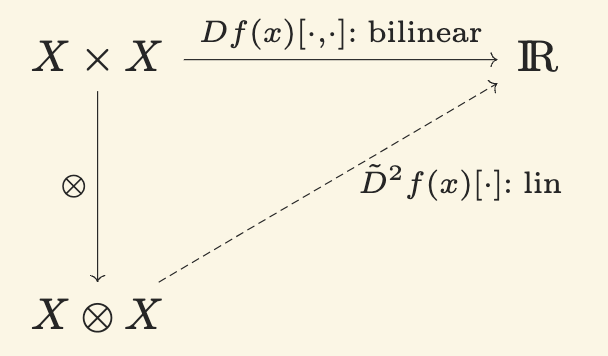
Figure 3. Universal property of tensor products.
where we often, with some abuse of notation, drop the tilde.
Let’s try to understand this better. Say we have a function $f:\R^n\to\R$. Then $\mathrm{D}^3f(x):\R^n\times \R^n \times \R^n\to\R$ is trilinear and can be seen as a linear function $\tilde{\mathrm{D}}^3f(x):\R^n \otimes \R^n \otimes \R^n \to \R$,
$$\begin{aligned}\tilde{\mathrm{D}}^3f(x):\R^n \otimes \R^n \otimes \R^n \ni &\mathrm{d} x_1 \otimes \mathrm{d} x_2 \otimes \mathrm{d} x_3 \\ &\to \tilde{\mathrm{D}}^3f(x)[\mathrm{d} x_1 \otimes \mathrm{d} x_2 \otimes \mathrm{d} x_3] \in \R.\end{aligned}$$
We know that $\mathrm{d} x_1 \otimes \mathrm{d} x_2 \otimes \mathrm{d} x_3$ with $\mathrm{d} x_i\in\R^n$ can be seen as a vector
$$\mathrm{d} x_1 \otimes \mathrm{d} x_2 \otimes \mathrm{d} x_3 = (\mathrm{d} x_{1i} \otimes \mathrm{d} x_{2j} \otimes \mathrm{d} x_{3k})_{ijk},$$
so the linear map $\tilde{D}^3f(x):\R^n \otimes \R^n \otimes \R^n \to \R$ is a map $$\tilde{D}^3f(x)[\mathrm{d} x_1 \otimes \mathrm{d} x_2 \otimes \mathrm{d} x_3] = \sum_{i,j,k} a_{i,j,k}(x) \cdot (\mathrm{d} x_{1i} \otimes \mathrm{d} x_{2j} \otimes \mathrm{d} x_{3k}).$$ In fact,
$$a_{i,j,k}(x) {}={} \frac{\partial^3 f(x)}{\partial x_i \partial x_j \partial x_k}.$$
These can be thought of as the “coordinates” of the third-order total derivative, which is a tensor8.
Let us look at an application: Let $f:\R^n\to\R$ and let $X$ be a random variable. Let $\bar{X} = {\rm I! E}[X]$. Then,
$${\rm I\! E}[\mathrm{D}^kf(\bar{X})[h, \ldots, h]] = {\rm I\! E}[\mathrm{D}^k f(\bar{X})[h^{\otimes k}]] = {\rm I\! E} \left[\sum_{ \substack{ \iota = (i_1, \ldots, i_k)\\ 1 \leq i_1, \ldots, i_k \leq n } } f_{x_{\iota}}(\bar{X})h^{\iota}\right],$$
where we used some convenient notation; firstly, $\iota$ is a multiindex, and we denote $$f_{x_{\iota}} = \frac{\partial^{|\iota|} f}{\partial x_{\iota}} = \frac{\partial^{i_1+\ldots+i_k} f}{\partial x_{i_1}\ldots\partial x_{i_k}},$$ and $h^{\otimes \iota} = h_{i_1}h_{i_2}\ldots h_{i_k}$.For example, using $h = X - \bar{X}$,
$$\begin{aligned} {\rm I\! E}[\mathrm{D}^2 f(\bar{X})[h,h]] {}={}& \sum_{i_1, i_2 = 1}^{n}\frac{\partial^2 f(\bar{X})}{\partial x_1 \partial x_2}{\rm I\! E}[h_{i_1}h_{i_2}] \\ {}={}& \sum_{i_1, i_2 = 1}^{n}\frac{\partial^2 f(\bar{X})}{\partial x_1 \partial x_2}{\rm Cov}(X_{i_1}, X_{i_2}). \end{aligned}$$
No wonder, the expectation of the second total derivative of $f$ is associated with a covariance (which provides second-order information).We can further define the skewness tensor
$$S_{i_1, i_2, i_3} = {\rm I\! E}[h_{i_1}h_{i_2}h_{i_3}],$$
where $h = X - \bar{X}$, with $\bar{X} = {\rm I\! E}[X]$. Then, $${\rm I\! E}[\mathrm{D}^3 f(\bar{X})[h, h, h]] = \sum_{i_1,i_2,i_3=1}^{n}\frac{\partial^3 f(\bar{X})}{\partial x_{i_1}\partial x_{i_2}\partial x_{i_3}}S_{i_1, i_2, i_3}.$$ This allows us to apply the above Taylor expansion. It is$$\begin{aligned} {\rm I\! E}[f(X)] {}={}& {\rm I\! E}\Big[f(\bar{X}) + \mathrm{D}f(\bar{X})[h] + \frac{1}{2!}\mathrm{D}^2f(\bar{X})[h^{\otimes 2}] \\ &+ \frac{1}{3!}\mathrm{D}^3f(\bar{X})[h^{\otimes 3}] + \frac{1}{4!}\mathrm{D}^4f(\bar{X})[h^{\otimes 4}] + R(h)\Big] \\ {}\approx{}& f(\bar{X}) + \frac{1}{2!}\sum_{i_1, i_2 = 1}^{n}\frac{\partial^2 f(\bar{X})}{\partial x_1 \partial x_2}P_{i_1, i_2} \\ &\quad {}+{} \frac{1}{3!}\sum_{i_1,i_2,i_3=1}^{n}\frac{\partial^3 f(\bar{X})}{\partial x_{i_1}\partial x_{i_2}\partial x_{i_3}}S_{i_1, i_2, i_3} \\ & \quad {}+{} \frac{1}{4!}\sum_{i_1,i_2,i_3, i_4=1}^{n}\frac{\partial^4 f(\bar{X})}{\partial x_{i_1}\partial x_{i_2}\partial x_{i_3}\partial x_{i_4}}K_{i_1, i_2, i_3, i_4}, \end{aligned}$$
where $P$, $S$, and $K$ are the variance-covariance, skewness, and kurtosis tensors.
Interchanging integrals and derivatives
Kammar9 has shown the following dominated convergence result that a allows to interchange the Fréchet derivative and integrals.
- For almost every $\omega \in A$, $f(\omega, \cdot)$ is Fréchet-differentiable
- For all $x\in U$ and $h\in X$, $f(\cdot, x)$ and $\mathrm{D} f(\cdot, x)[h]$ are integrable on $A$
- There is an integrable function $\theta:\Omega \to {\rm I\!R}$ on $A$ such that for almost every $\omega \in A$ it is $\|\mathrm{D} f(\cdot, x)\| \leq \theta(\omega)$
Then, $F(x) \coloneqq \int_A f(\omega, x) \mathrm{d}\mu$ is Fréchet-differentiable on $U$ and
$$\mathrm{D}\left(\int_A f(\omega, x) \mathrm{d}\mu\right)[h] = \int_A \mathrm{D}f(\omega, x)[h]\mathrm{d}\mu.$$
Next, we’ll see how the Fréchet derivative will be useful to solve optimization problems in Banach spaces using the Lagrange multiplier theorem.
-
Recall that the Landau notation $f(h) = o(g(h))$ as $|h|\to 0$ means that $\lim_{|h|\to 0}f(x)/g(x) = 0$. ↩︎
-
M. Spivak, Calculus on manifolds: a modern approach to classical theorems of advanced calculus, 1968; see mainly Chapter 2 ↩︎
-
See Wikipedia page (Fréchet derivative), accessed on 16 November 2023 ↩︎
-
Francis J. Narcowich, Fréchet & Gâteaux derivatives and the chain rule, 2021, link, accessed on 17 November 2023 ↩︎
-
Eberhard Zeidler. Applied functional analysis: main principles and their applications. Springer-Verlag, 1995, link, accessed on 3 June 2025 ↩︎ ↩︎
-
Alan Edelman and Steven G. Johnson, Matrix Calculus for Machine Learning and Beyond, MITOpenCourseware, 18.S096 | January IAP 2023 | Undergraduate, accessed on 3 June 2025 link; see in particular Lectures 2, 3, and 12. ↩︎
-
Planetmath, Taylor’s formula in Banach spaces, accessed on 2 July 2025 ↩︎ ↩︎
-
$\mathrm{D}^3f(x)$ is indeed a tensor. It is a linear map $\mathrm{D}^3 f(x) \in {\rm Hom}(V^{\otimes 3}, W)$ and ${\rm Hom}(V^{\otimes 3}, W) \cong (V^{\otimes 3})^* \otimes W$ (in the finite-dimensional case). ↩︎
-
O. Kummar, A note on Fréchet diffrentiation under Lebesgue integrals, available here; accessed on 12 May 2026 ↩︎